Dimensions
D 11 cm · H 26 cm


Meet the wine before you taste it.
Flavour is more than taste. It is the work of all our senses, carrying us through memory, imagination and time.
Maria Baleva, M.Arch.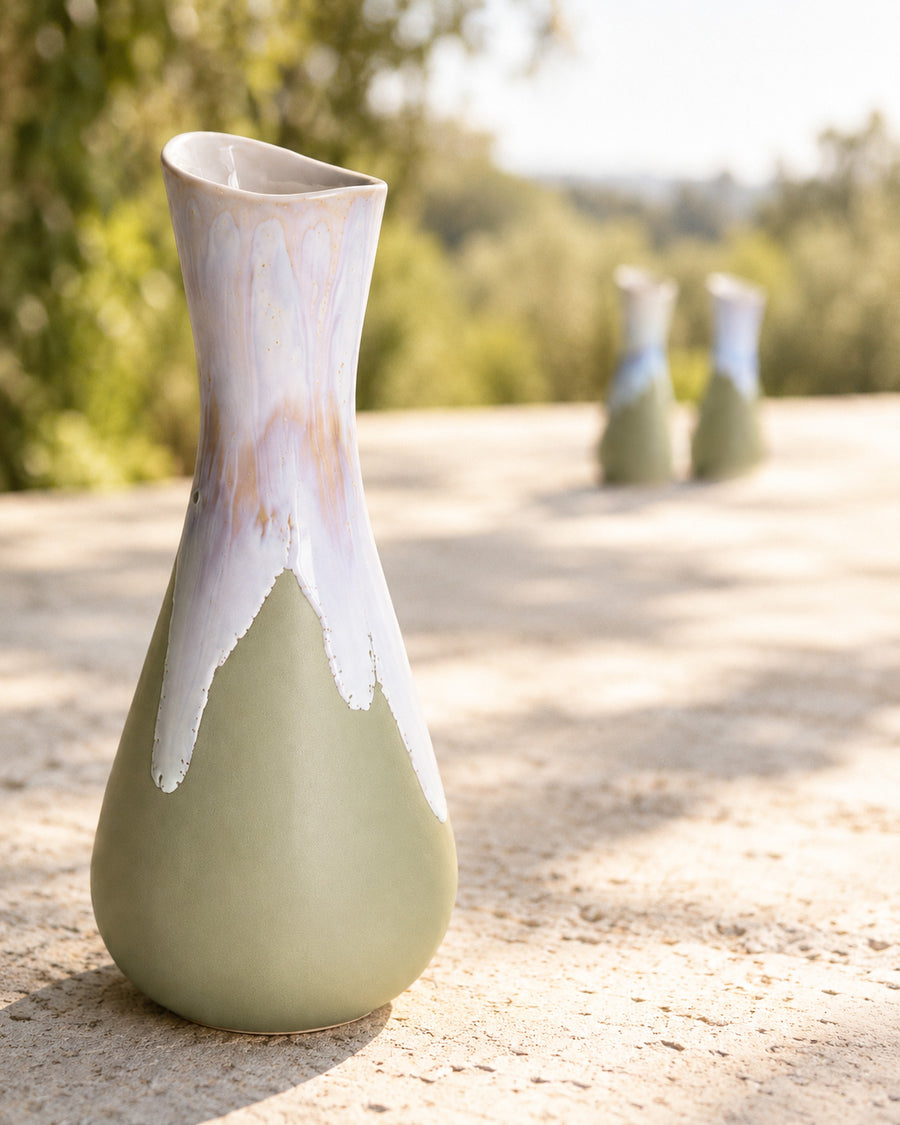
The pearlescent upper glaze catches the light like the wine's delicate white flowers and acacia — the nose met first.
A cool sage-green runs through the pale body, holding the wine's fresh, mineral edge.
The soft, symmetrical base carries the vibrant, round palate of white cherry and peach.
A pale, matte body holds the wine's fullness without weight, so the aromatics stay bright and airy.
As the form rises it narrows; the multi-layered fruit-and-floral character reads in the shift from fullness to lift.
An extended neck and a gently asymmetric opening carry the wine into a long, refined finish of freshness and elegance.
Pearlescent light, a pale matte body and a soft, rounded base carry the wine's floral, white-fruit character. A cool sage-green thread near the top holds its fresh, mineral edge — roundness first, freshness and minerality staying through a long, refined finish.
Aromatic white blends — floral, honeyed and herbal, with ripe stone fruit, lifted by a long, fresh finish.
Delicate white flowers and acacia over white cherry and peach — vibrant, round and mineral, with a long, refined finish.

Pale yellow with subtle greenish hues. The nose opens on delicate white flowers and acacia, with layers of white cherry and peach. Vibrant and round on the palate, well-balanced and multi-layered, with fruit and floral character lifted by a touch of minerality, closing on a long, refined finish of freshness and elegance.
A Calassi vessel works on the moment before the wine — the anticipation. Form, colour and texture wake the senses before the first pour, and the act of serving becomes part of how the wine is met. Poured into the glass, the wine arrives to senses already prepared. The cooling system holds an ideal temperature through the whole ritual, from opening to the last glass.
Designed to hold the wine at an ideal serving temperature throughout the ritual. The double-walled porcelain body holds cooling agents that regulate heat exchange and keep the temperature for up to two hours.
The base opens easily so the agents recharge in an ordinary refrigerator, ready for the next bottle. Developed as a dedicated companion to the vessel, it brings temperature control into the serving system while leaving the vessel itself unchanged.